

The Generational Wealth Rabbit Hole: The Vanderbilts and the Rockefellers

What the Rockefellers can teach us about wealth, succession, and thinking beyond one lifetime.

For weeks I've been down one of those internet rabbit holes that starts with a simple question and somehow ends with you reading about family constitutions, century old trusts, and annual Rockefeller retreats. I got sucked in not because I was looking for billionaire gossip but because such an interesting theme kept coming up: why are some families able to build wealth that lasts for centuries, and the majority lose their wealth after a generation or two?

For a personal finance nerd (and just someone infatuated with the kind of wealth that changes the course of a family) this stuff is enticing. The comparison you'll find again and again is the Rockefellers and the Vanderbilts. Two incredibly wealth families, two very different outcomes. The internet loves to turn it into a morality tale—"the Rockefellers were disciplined and the Vanderbilts blew it all." The truth is much more nuanced (and much more interesting).
The concept isn't really about making money, it's about how families think. The intentionality they put into the next generation. Whether you're hoping to pass down a business, a cabin, a few investment accounts, or simply strong traditions there are surprisingly practical lessons hidden in how some of history's wealthiest families approached succession.

To compare the two families, we're going to focus on three key areas. First, instilled values: what was each family passing down from one generation to the next, whether intentionally taught or simply absorbed through the way they lived? Second, family governance and decision-making: as families grow from a handful of people into hundreds of descendants, how do you get everyone rowing the boat in the same direction? And third, estate planning: both families started out absurdly wealthy, so what systems did they put in place to legally protect (and hopefully preserve) that wealth for future generations?
But before we can study where they went we have to look at where they began.

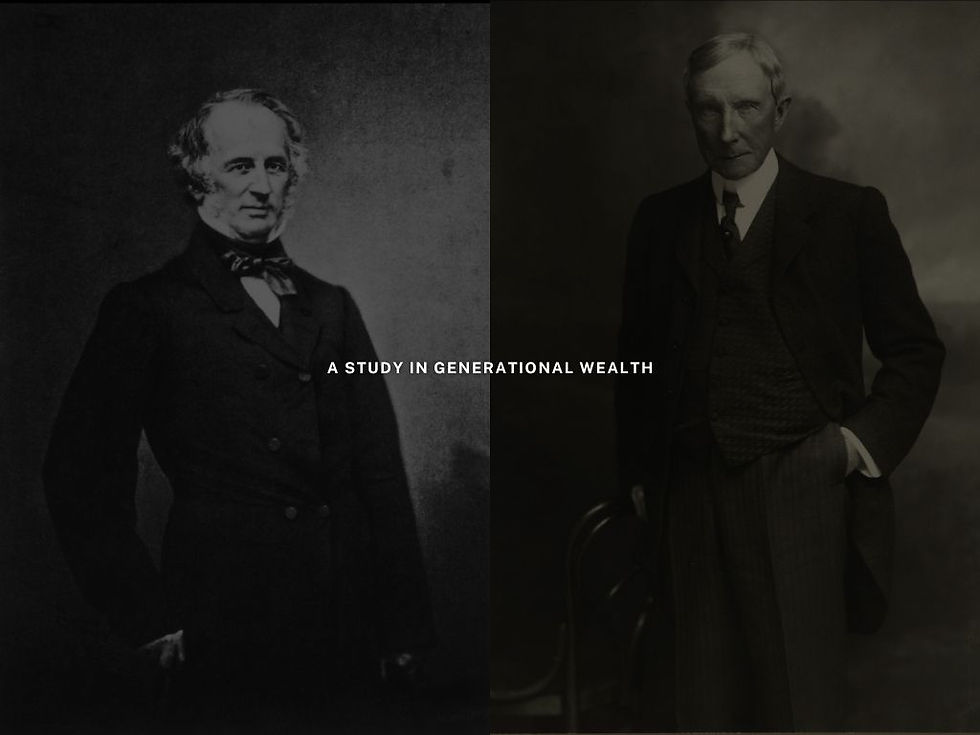
The Vanderbilt fortune began with transportation. Cornelius Vanderbilt built an empire first through steamships before shifting his focus to railroads, eventually creating the largest railroad network in the United States. By the time of his death in 1877, he was one of the richest men in the world, with a fortune worth multiple billions in today's dollars.
While the original Commodore was known for his relentless work ethic and business instincts, later generations became synonymous with the extravagance of the Gilded Age. Think Newport "cottages," Fifth Avenue mansions, lavish costume balls, European travel, yachts, and some of the most over the top displays of wealth in American history. If you've ever pictured the glamour and excess of old money America, chances are you've been picturing the Vanderbilts.
One of the most famous stories about the Vanderbilt family comes from a 1973 family reunion. It's often said that when around 120 Vanderbilt descendants gathered, there wasn't a single millionaire among them. Now that might be a bit of a dramatization—some descendants were still financially successful—but it illustrates a broader truth: by the 1970s, the unified Vanderbilt fortune had largely disappeared. The family's wealth had been divided, spent, invested, and dispersed over multiple generations, leaving nothing close to the wealth Cornelius and his son had once built.
That certainly doesn't mean the Vanderbilt legacy ended there. Several descendants went on to build successful careers of their own, perhaps most famously Gloria Vanderbilt, who reinvented herself as an artist, author, and fashion designer. Her designer denim line became one of the first true designer jean brands and helped establish her as a successful entrepreneur in her own right, independent of the family's original railroad fortune. You might also recognize her son, Anderson Cooper, the longtime CNN anchor, or actor Timothy Olyphant, who is also a Vanderbilt descendant.
The Rockefeller story also begins in the late 1800s, this time with oil. John D. Rockefeller Sr. founded Standard Oil in 1870 and went on to build what many historians consider the greatest personal fortune in American history. At his peak, his wealth has been estimated at roughly 2% of the entire U.S. GDP—an almost impossible amount of money to wrap your head around. To put that in perspective, GDP is the total value of every good and service produced in the country in a given year. In other words, Rockefeller controlled an mind boggling share of the American economy.
When people compare the Rockefellers and the Vanderbilts, the conversation often gets oversimplified. People like to take a general look at the two and say well the Vanderbilt's liked to party and the Rockefeller's were more buttoned up that's why they went in opposite directions, but I just don't think it's as simple as that.
Even if the original John D. Rockefeller was known for wearing relatively plain suits, he also traveled in private railroad cars with high end security, owned sprawling estates, collected world class art, and helped fund institutions like the Metropolitan Opera. The Rockefellers absolutely spent money—they simply spent it differently. Their luxury was quieter, more private, and often tied to legacy rather than spectacle.
I think that's an important distinction because it shifts the conversation away from whether they spent money and toward how they chose to spend it.
This was the first major difference that stood out to me. The Rockefellers didn't just pass down wealth—they intentionally tried to pass down a way of thinking about wealth. Over time, they developed a family constitution: not a legal document, but a written framework outlining the family's mission, values, expectations, and approach to stewardship. It reinforced principles like responsibility, education, philanthropy, humility, and long term thinking. More importantly, it signaled that family culture itself was something worth preserving.
The Vanderbilts also had values, and I don't think it's fair to paint them as a family without them. Family loyalty, ambition, appreciation for culture, philanthropy and social standing were all woven into the Vanderbilt legacy. The difference is that those values were largely passed down through individual households rather than reinforced through a broader family governance system. As the family grew, each branch naturally developed its own priorities, traditions, and identity.
My biggest takeaway wasn't that one family had "better" values than the other. It was that the Rockefellers treated values as something that required intentional preservation. They understood that if you want a family's culture to survive for generations, you can't simply hope it will—you have to actively teach it, reinforce it, and create systems that keep it alive.
As families grow from a handful of people into hundreds of descendants, keeping everyone aligned becomes a challenge of its own. This is where the Rockefeller family really stands out. While we don't know the intimate details of their family governance (and there are plenty of rumors and stories floating around online) but what is publicly known is that they have prioritized multi generational family meetings and retreats for decades.
These gatherings are designed to do more than bring relatives together, they help educate younger generations on the family's history, values, philanthropy, and responsibilities. The goal isn't just to pass down wealth, but to pass down stewardship. The acknowledgement of what's being entrusted to their care.
One of my biggest takeaways from this was the idea that people protect what they feel responsible for. If you want future generations to appreciate something, you have to include them in it. Responsibility becomes less of a burden and more of a privilege when people feel like they are part of building and preserving something meaningful.
Is it really that fun of a fact? No, but it's true. 70% of wealthy families lose their money by the second generation, and 90% lose their wealth by the third generation. So how did the Rockefellers legally protect their wealth generation after generation? This is of course a general overview take, with only the information we can know from the outside, but the estate planning we will look at centers around trusts.
Rather than simply handing wealth directly to each generation, trusts allowed the family to create a structure around how that wealth could be managed, protected, and distributed over time. The goal wasn't just to transfer money—it was to prevent the fortune from being fragmented, poorly managed, or forced into liquidation as the number of people in the family grew.
The overarching point is simply to get you thinking about the legacy you will be able to pass down. You don't have to be a billionaire to care about the values your family is built around or to make smart financial decisions that can set your family apart. The Rockefellers are an extreme example, but the principles are surprisingly practical: being intentional about your money, thinking ahead, and considering what you want the next generation to inherit—not just financially, but in the way your family operates.
Whether it's creating a family constitution, having conversations around money, setting up a trust, or simply being more thoughtful about the values you want to pass down, these are things any family can start thinking about long before they ever reach Rockefeller level wealth.


Comments